
Thank you for visiting our Centennial Exhibit.
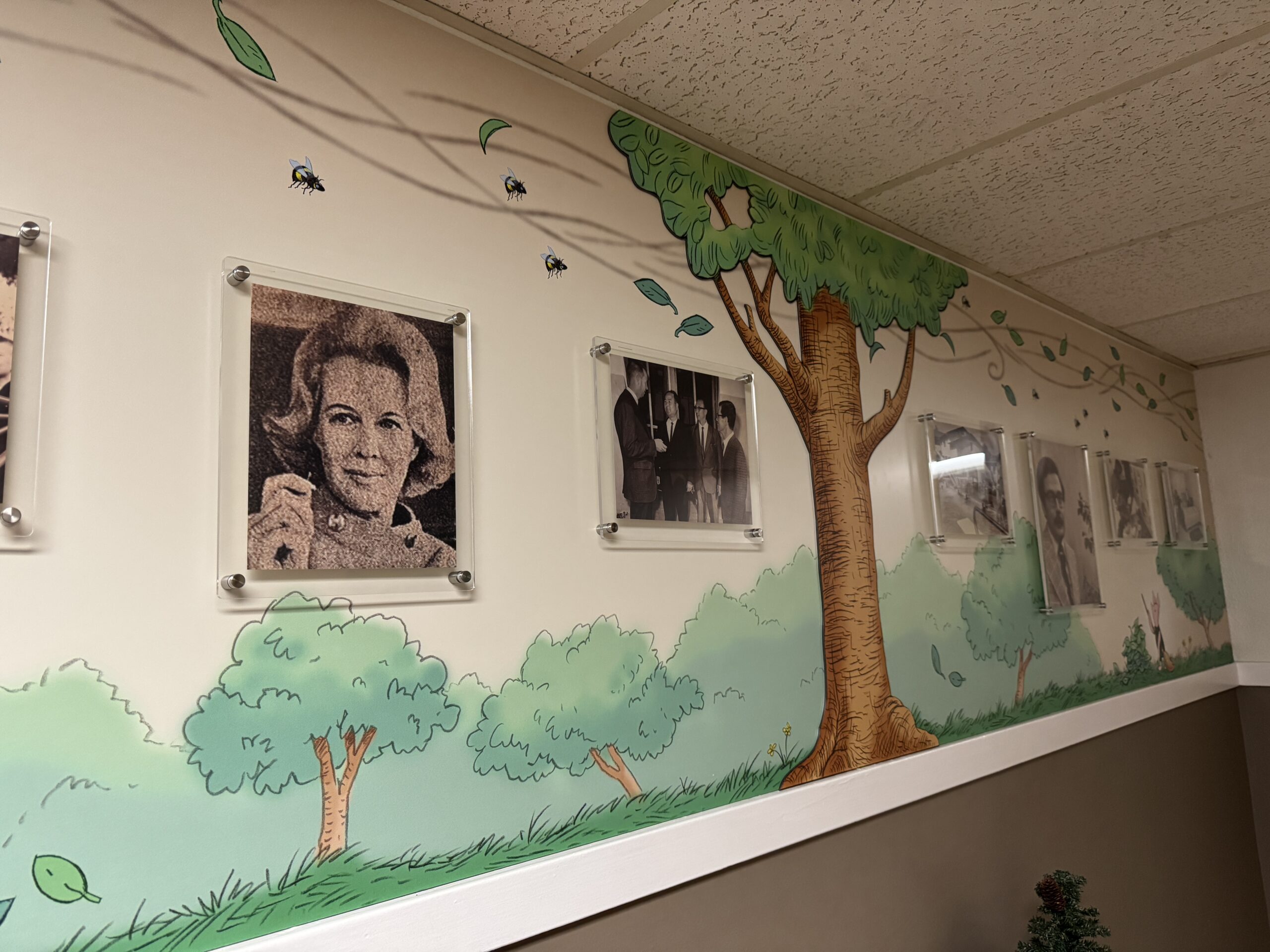
The timeline below walks you through our Centennial Exhibit, honoring 100 years at our historical headquarters in Altadena, including the founding on March 12, 1888 as the Boys’ & Girls’ Aid Society of Los Angeles County.
1888: a home takes root
1. Established on March 12, 1888, we were founded as The Boys’ & Girls’ Aid Society of Los Angeles County. The Board of Trustees opened a little six-room cottage erected by W.H. Holmes, located in downtown Los Angeles at 13 Fuller Street in Los Angeles, which later became 2150 Glowner Street, and was purchased for $2,350.
2. Initially a beer garden business, the South Pasadena property was donated to the home in 1898 by Miss Olive Cleveland, cousin of former President Cleveland. The new three-story dormitory, completed in 1903, had the capacity to serve 139 children and operated for 23 years. During this time, Miss Anne Stoye served as executive director.
3. This is the front of the South Pasadena home. In 1921, the Board of Trustees purchased five acres of land in Altadena and contracted The Orndorff Construction Company to construct a group of buildings, including main building, hospital, four dormitories and boiler house, and laundry room. Due to a fire in December 1925, the children were moved temporarily before they could move into their new facility in Altadena.
4. Photos of four of the founding Board of Trustees and the founding members’ ten signatures. William H. Workman was the 18th mayor of Los Angeles and was instrumental in building MacArthur Park and the new city hall, as well as revising the city charter to transfer mayoral duties as city judge to a separate judicial figure. M. L. Wicks was a pioneer lawyer and beneficiary of the Southern Pacific Railroad, partner of D.O. Mills, Leland Stanford, Huntington, and Mag Holdings Trust. Col. James Ayers was elected to the Constitutional Convention, which framed the foundation of California laws, where he ensure that both men and women could attend the University of California. Robert M. Widney was the founder of the Los Angeles Chamber of Commer and University of Southern California.
5. Founding Board of Trustees member Mrs. Helen A. Watson served as a volunteer superintendent and first executive director. She was the first matron for the Los Angeles Police Department, prompted by an argument to secure an appointment of a woman who can search female inmates rather than a man conducting that duty. In addition, she supported the work with young boys and girls, transferring the duties of police who were dealing with them either because they had become criminals or they had become victims of crime.
1926: building our historical headquarters
6. Once the five acres of land was purchased, famed architect Myron Hubbard Hunt was commissioned to design “an outstanding child-oriented facility.” Plans for the structure were prepared by Mr. Hunt, and when completed, the building represented an expenditure of about $800,000, which would be about $13 million today. Due to a fire in 1925, the South Pasadena location was condemned, and the children were moved temporarily until the new historical headquarters was completed.
7. Original print of the new historical headquarters of The Boys’ and Girls’ Aid Society of Los Angeles County in Altadena, now known as Five Acres.
8. On July 15, 1926, “everything was ready for the reception of our big family” and there were 130 children living in the home, providing cottage living instead of a sterile institutional environment. One cottage building, donated by the Junior League of Pasadena, still bears a special dedication plaque.
9. Children were headed to school and lined up to board a school bus in front of the new residential facility in Altadena.
10. Children benefited from country living with a few cottages in close proximity. The new campus and concept of enclosing a large, landscaped play area with housing and other services continue to be used today. In 1926, the facility employed 10 dormitory matrons, 1 dining room matron, 2 nurses, 1 housekeeper, a cook, an assistant cook, dishwasher, laundress, gardener, engineer, janitor, and steward and while has been somewhat modified in 100 years. The overall model remains the same.
11. On the spacious five acres of land, children enjoyed the large landscape for recreation and gardening.
1940: from orphanage to healing home
12. Trends reported by the U.S. Children’s Bureau indicated that there was an upward swing in the number of young persons at work, particularly in areas where defense production existed. Another significant trend noted that day care for young children whose mothers were employed was rapidly coming to the fore as one of the most urgent social needs of the defense period. Our agency received War Ration books for the children living at our historical headquarters. In the annual meeting on January 12, 1942, the superintendent reported, “As one of the oldest social agencies in this area we can expect our responsibilities to increase, and we must have vision and capacity to recognize and to accept such responsibility as may arise from the demands of this total war effort.”
13. In 1945, the name Five Acres was added to reflect the agency as a home environment rather than an institution.
14. Children learned how to live in a family setting and care for their environment.
15. During this period, the Board of Trustees also changed Five Acres’ purpose from custodial care to a casework agency.
16. In 1958, Five Acres joined the Child Welfare League of America to elevate the agency’s purpose, function, and operations, as well as incorporate a system of evaluation to improve services.
17. Children enjoyed playing in nature on the Five Acres property.
18. Nursing care was provided on the property and continues today.
19. Recreation, games, music, and dining together were common activities while living in the cottage setting.
1965: leaders who shaped Five Acres
20. The San Marino Area Auxiliary Guild of Five Acres was established in 1965. Using the concept of paper dolls, boy and girl cutouts later became the image of the Five Acres logo.
21. In 1966, a World War II veteran, missionary, and former social worker, Newell Erickson was appointed as the new executive director and served for 15 years. At that time, Five Acres impacted 318 children annually and had a budget of $285,000. Permanency was not the focus, so siblings and families were not part of the treatment.
22. Kay Gable, actor Clark Gable’s wife, was one of the notable supporters. As a member of the San Marino Area Auxiliary Guild, the members helped to raise awareness of the mission and work of Five Acres.
23. Mr. Erickson engaged community supporters to expand residential programs, such as opening the first group home in Altadena.
24. Built in 1968, the pool, a gift from the Cook/Stewart family, was a fun diversion for children and youth who lived on the property. Forty years later, it needed replastering and safety upgrades. Women Helping Youth, a generous group of philanthropic women in Pacific Palisades, made a grant to fund the project. The Cook family, whose legacy and generosity continues to this day with family members Ann Stewart, Craig and Cheryl Stewart, and Katherine and Paul Johnson.
25. In 1973, Millard Ryker was appointed as the Five Acres executive director.
26. Under Mr. Ryker’s leadership, Five Acres supported the education of children living at the facility. Mr. Ryker was also instrumental in opening the Five Acres Research Department.
27. Mr. Ryker expanded the Five Acres Group Home Program in the community. During his tenure, Five Acres voluntarily joined the Council on Accreditation, an independent, nonprofit organization that accredits human service providers, ensuring they meet established standards of quality and effectiveness. In addition, he added creative programs such as art therapy and recreation groups in woodshop and cooking, and he led with a commitment to do “whatever it takes” to help the children.
1984: growing programs and our impact
28. Robert Ketch, who began as a social worker at Five Acres, was appointed executive director in 1984. He started the foster care program in 1988.
29. Under Mr. Ketch’s 28 years in leadership, Five Acres was instrumental in the Los Angeles County Department of Children and Family Services Family Finding pilot in 2006.
30. Our Deaf Services program, the only Los Angeles County Department of Mental Health program for the deaf and hard of hearing, was established in 1990.
31. Five Acres’ Children’s Guild was established in 1990 to provide activities for the residential children.
32. Loyola High School students seen volunteering in January 1999 as part of their academic service project.
33. Numerous community-based programs and therapeutic services were established, growing the agency’s budget to $28 million and impacting 4,200 clients annually. Mr. Ketch established these additional programs: In 2000, he started therapeutic behavioral services program. In 2004, the Grace Center domestic violence program became an affiliate of Five Acres.
34. In 2000, Five Acres received an adoption agency license and established the program.
35. Our Adoption Promotions Support Services Program was launched in 2006.
36. In 2006, Five Acres’ Wraparound program was established. A year later, the Pasadena Mental Health Center became an affiliate of Five Acres. In 2008, the intensive treatment foster care program was established.
2011: safety, well-being, and permanency
37. Chanel Boutakidis, who began as a therapist at Five Acres and started our Permanency Department in 2008, became the chief executive officer in 2011.
38. Under Mrs. Boutakidis’ leadership, Five Acres adopted the change of the mission from “raising children to become productive adults” to “ensure that every child has safety, well-being, and permanency.”
39. From 2012-2018, Five Acres implemented the vision of being a data-driven organization that uses data to improve services, and to share across multiple platforms, including at county and state levels. Our Zeilstra Research & Training Center is the hub for our data collection spanning from client measures to evidenced-based practices.
40. In celebration of Five Acres’ 130th birthday in 2018, Los Angeles County Supervisor Kathryn Barger recognized March 12 as “Five Acres Day” in Los Angeles County. Ms. Barger’s official proclamation took place in 2018 at the LA County Board of Supervisors meeting in Downtown LA.
41. With the onset of the worldwide COVID-19 pandemic, Five Acres transitioned to telemedicine and updated its technology to support the continuation of services. In 2021, the Family First federal reform was announced and Five Acres pivoted to meet the new federal guidelines allowing to continue providing mental health services to children who have been traumatized. In 2022, Five Acres was the first child welfare organization to negotiate a CalAIM contract with healthcare
42. In January 2025, the Eaton Fire destroyed many homes and businesses in Altadena. Five Acres’ historical headquarters was thankfully spared.
our next century of heart & home
43. Five Acres’ Prevention Programs have experienced significant growth, and new contracts with healthcare, including private healthcare, have increased access to services across six counties in Southern California, impacting over 300,000 to date.
44. Launched in 2025, Five Acres’ Wear Your Heart initiative increases access to early mental health support through parent education, resources, community linkages, and referrals.
45. As we embrace the next century, we are grateful to our Five Acres team members who fulfill our mission, promoting safety to children in foster care, expanding private healthcare programs and community-based services to bring well-being to families, and increasing permanency so every child can have a loving, forever home.
46. Five Acres is supported by generous donors, community partners, corporations, and celebrities like Sam Jaeger, Matthew Lillard, Crosby & Nash, Noah Wyle, Jane Kaczmarek, Matt Nix, and Emily Deschanel.